
The Biggest AI Cybersecurity Threats in 2026
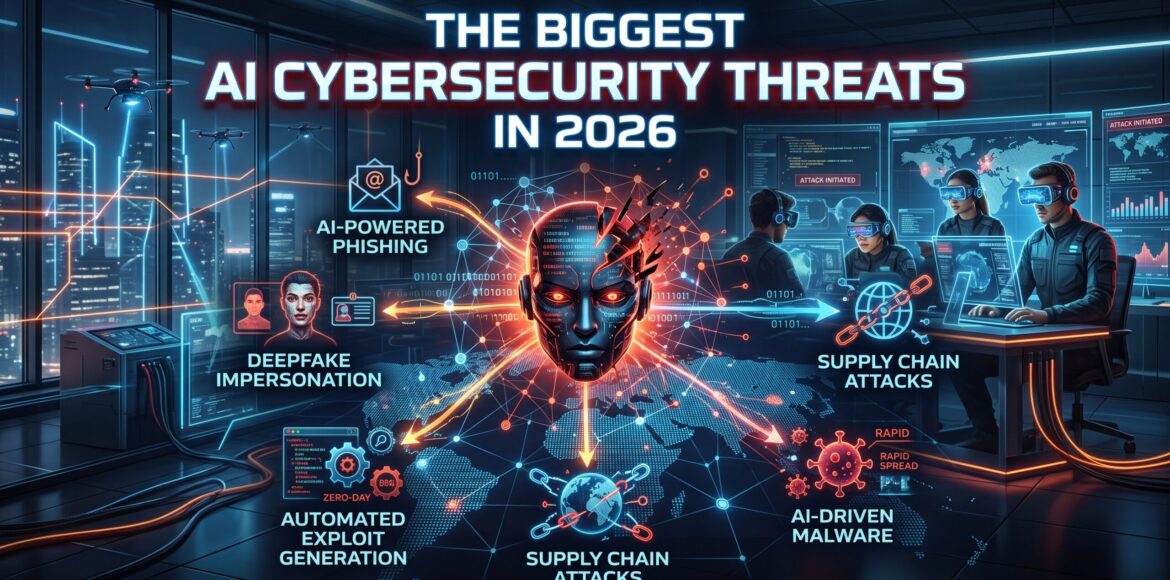
Table of Contents
Artificial intelligence is changing the way businesses work. Companies are using AI to automate tasks, analyze information, support customers, write software, detect problems, and make everyday decisions.
But the same technology that makes organizations more productive can also create new cybersecurity risks.
In 2026, the relationship between AI and cybersecurity has become more complicated. Attackers can use AI to speed up parts of cyberattacks, while organizations are also discovering that their own AI systems can become targets.
Security researchers are increasingly focused on threats such as prompt injection, AI-powered social engineering, deepfakes, excessive AI permissions, data leakage, model poisoning, and attacks against AI applications themselves. Gartner identified deepfakes, AI application compromise, prompt injection, and software supply chains among critical threats for cybersecurity leaders in its 2026–2027 threat landscape.
The challenge is no longer simply protecting computers from hackers.
Businesses now need to protect AI systems, the data they use, the tools they can access, and the people who rely on their decisions.
So, what are the biggest AI cybersecurity threats in 2026?
1. AI-Powered Phishing and Social Engineering
Phishing is not new, but AI is making it easier to create convincing messages at scale.
Traditionally, phishing emails often contained obvious warning signs such as poor grammar, strange wording, or generic messages.
AI can help attackers produce more personalized communication.
AI can also help generate:
- Personalized phishing emails
- Fake customer messages
- Business email compromise attempts
- Fake support conversations
- Multilingual scams
- Personalized social engineering campaigns
2. Deepfakes and Synthetic Identity Attacks
One of the most visible AI security threats is the rise of deepfake audio, video, and images.
A criminal may attempt to imitate a company executive, employee, customer, or other trusted person.
For example, imagine receiving a video call from someone who appears to be a senior executive asking for an urgent financial transfer.
The video looks authentic.
The voice sounds familiar.
The request appears believable.
That creates a difficult security situation.
3. Prompt Injection Attacks
Prompt injection is one of the most important security issues affecting AI applications.
A prompt injection attack occurs when an attacker places instructions into content that an AI system processes.
The dangerous part is that the malicious instruction does not necessarily come directly from the user.
It could be hidden inside:
- A website
- An email
- A document
- A PDF
- A database record
- A webpage
- A third-party data source
Imagine an AI assistant that is allowed to read emails and summarize them.
4. AI Agents With Too Much Permission
AI agents are becoming capable of doing more than generating text.
They can potentially:
- Read files
- Search databases
- Send messages
- Access applications
- Call APIs
- Create documents
- Modify information
- Perform business workflows
OWASP describes this as excessive agency, where an AI system has excessive functionality, permissions, or autonomy and can perform damaging actions based on unexpected or manipulated outputs.
5. Sensitive Data Exposure
AI systems often work with large amounts of information.
That can include:
- Customer data
- Employee information
- Financial records
- Business documents
- Source code
- Internal emails
- Contracts
- Product information
- Passwords or credentials
6. AI Application and Model Attacks
AI itself can become an attack target.
Attackers may try to manipulate models, exploit weaknesses in AI applications, steal sensitive information, or abuse the infrastructure surrounding an AI system.
This means companies need to secure both:
The traditional application layer
and
The AI layer.
An AI chatbot connected to a company’s internal systems, for example, needs more than ordinary application security.
The organization also needs to consider how the model interprets instructions, accesses information, interacts with tools, and handles untrusted content.
7. AI Hallucinations Becoming Security Problems
AI systems can sometimes generate incorrect information.
Normally, an incorrect answer may simply be inconvenient.
But when an AI system is connected to real business tools, the consequences can become more serious.
For example, an AI system could misunderstand a request and:
- Recommend the wrong configuration
- Provide an incorrect security instruction
- Modify information incorrectly
- Trigger an inappropriate workflow
- Make a misleading recommendation
The risk becomes greater when AI output is automatically converted into an action.
Why AI Agents Need Special Security
Traditional software usually follows predefined instructions.
AI agents can interpret information, reason through tasks, interact with tools, and make decisions based on changing context.
That flexibility creates new security challenges.
NIST’s 2026 analysis of AI-agent security feedback found broad agreement that agents create novel security threats and that traditional cybersecurity principles need adaptation for agent-based systems.
How Businesses Can Protect Against AI Cybersecurity Threats
There is no single solution that eliminates every AI security risk.
Businesses should instead build multiple layers of protection.
1. Control AI Access
Give AI systems only the permissions required for their specific tasks.
Avoid unnecessary access to sensitive databases, files, applications, and administrative functions.
2. Protect Sensitive Data
Create clear rules for handling confidential information.
Employees should understand what information can be shared with public or third-party AI tools.
3. Validate AI Outputs
Important AI-generated recommendations should be checked before they are used for high-impact decisions or system changes.
4. Use Human Approval for High-Risk Actions
Actions involving money, deletion, account permissions, production systems, or sensitive information may require explicit approval.
5. Monitor AI Activity
Organizations should monitor what AI applications and agents are accessing and what actions they are performing.
Unexpected behaviour should trigger investigation.
6. Test AI Systems Before Deployment
Security testing and red-team exercises can help organizations discover weaknesses before attackers find them.
NIST’s 2026 AI-agent research highlights red-teaming as one method for assessing how systems behave under adversarial pressure.
The Future of AI Cybersecurity
Attackers can use AI to increase speed and personalization.
Security teams can use AI to analyze more information, detect suspicious behaviour, automate investigations, and respond faster.
At the same time, businesses will need to secure a growing number of AI agents and applications.
This means future cybersecurity will likely involve a combination of:
- Traditional security controls
- AI-specific security testing
- Identity management
- Data protection
- Agent permission controls
- Continuous monitoring
- Human oversight
- Secure AI development
The organizations that adapt early will be better positioned to use AI without treating security as an afterthought.