
Digital Twins and IoT: How Connected Data Creates Smarter Systems
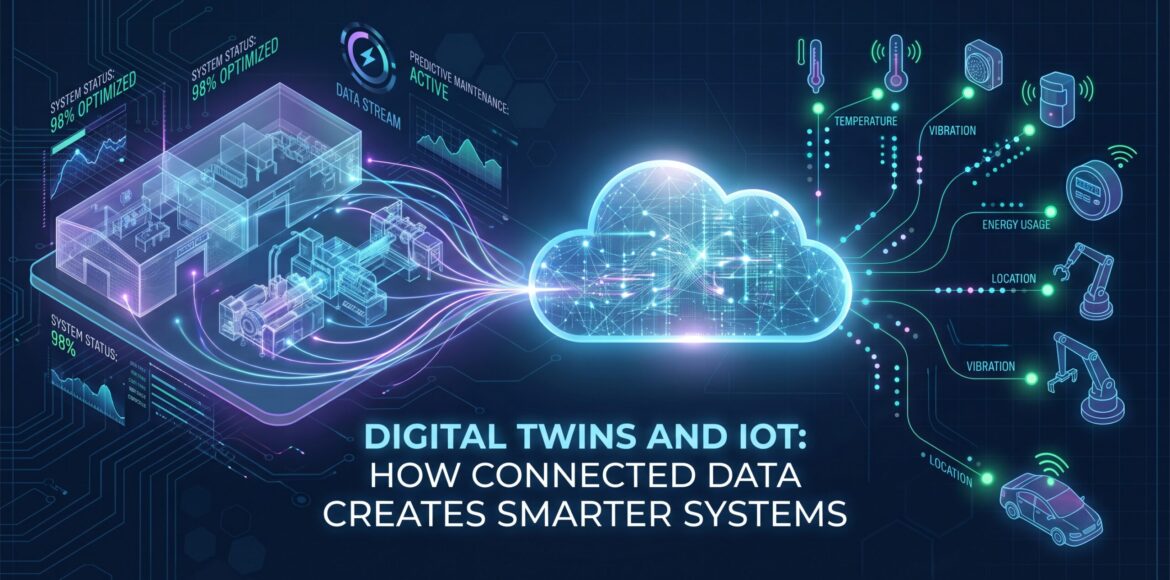
Table of Contents
The way businesses manage machines, buildings, vehicles, factories, and other physical systems is changing quickly. Instead of waiting for something to break or relying only on manual inspections, organizations can now collect real-time information from connected devices and use that data to understand what is happening.
Two technologies are playing an important role in this change: the Internet of Things (IoT) and digital twins.
IoT connects physical devices to networks so they can collect and exchange data. A digital twin takes this connected information a step further by creating a virtual representation of a physical object, system, or environment.
When these technologies work together, businesses can monitor real-world systems, identify problems, test different scenarios, improve performance, and make more informed decisions.
But how exactly does this work, and why are digital twins and IoT becoming increasingly important?
What Is the Internet of Things (IoT)?
The Internet of Things, commonly called IoT, refers to physical devices that contain sensors, software, connectivity, or other technologies that allow them to collect and exchange data.
These devices can include:
- Industrial machines
- Smart meters
- Vehicles
- Security cameras
- Medical equipment
- Factory sensors
- Wearable devices
- Smart appliances
- Environmental sensors
- Building management systems
What Is a Digital Twin?
A digital twin is a virtual representation of a physical object, process, system, or environment.
The digital model can use information collected from sensors and other connected technologies to represent what is happening in the real world.
For example, a manufacturing company could create a digital twin of an entire production line.
The physical factory contains machines, sensors, motors, conveyor belts, and other equipment. IoT devices collect information from those systems, while the digital twin uses that information to provide a digital view of the production environment.
The model can show things such as:
- Machine performance
- Temperature
- Energy consumption
- Production speed
- Equipment condition
- Maintenance requirements
- Potential operational problems
The important difference is that a digital twin is not simply a static 3D model.
How Do IoT and Digital Twins Work Together?
oT and digital twins complement each other.
Think of the relationship this way:
Physical system → IoT sensors → Data → Digital twin → Analysis → Action
IoT devices collect information from the physical environment.
That data is transferred to software platforms where it can be processed and analyzed.
The digital twin uses the information to represent the current state of the physical system.
AI, analytics, or other software can then identify patterns and provide useful insights.
The business can use those insights to make decisions or automatically trigger actions.
For example:
- A sensor detects increasing vibration in a machine.
- The IoT system sends the measurement to the platform.
- The digital twin reflects the machine’s changing condition.
- Analytics identifies the vibration as unusual.
- The system alerts the maintenance team.
- The team inspects the machine before a major failure occurs.
This creates a much more proactive approach to managing physical systems.
Why Connected Data Matters
Data becomes more valuable when it is collected continuously and connected to the systems that need it.
Traditional maintenance, for example, may rely on fixed schedules.
A machine might be inspected every three months regardless of its actual condition.
With IoT and digital twins, maintenance can become more condition-based.
Digital Twins in Manufacturing
Manufacturing is one of the strongest use cases for digital twins.
Modern factories contain many interconnected machines and processes. A small problem in one part of the production line can affect the entire operation.
A digital twin can provide a broader view of the system.
Manufacturers can use digital twins to monitor:
- Production lines
- Machinery
- Robotics
- Energy usage
- Product quality
- Equipment performance
- Factory layouts
Digital Twins in Smart Buildings
Digital twins are also becoming useful for buildings and facilities.
A smart building can contain sensors that monitor:
- Temperature
- Humidity
- Lighting
- Energy consumption
- Occupancy
- Air quality
- Equipment performance
The Role of Artificial Intelligence
AI can make digital twins significantly more useful.
A digital twin can collect and display information, but AI can help identify patterns within large amounts of data.
For example, AI could analyze sensor readings and detect behaviour that may be difficult for humans to notice manually.
AI can support:
- Anomaly detection
- Predictive maintenance
- Forecasting
- Process optimization
- Automated decision support
- Pattern recognition
- Simulation analysis
Benefits of Digital Twins and IoT
When implemented correctly, connected IoT and digital twin systems can provide several benefits.
Better Visibility
Organizations can gain a clearer view of what is happening across physical systems.
Faster Problem Detection
Real-time sensor data can help identify unusual conditions earlier.
Reduced Downtime
Predictive maintenance can help organizations address potential equipment problems before major failures.
Improved Efficiency
Data can reveal where energy, time, materials, or other resources are being wasted.
Better Decision-Making
Businesses can use real-world data instead of relying entirely on assumptions.
Safer Operations
Monitoring can help identify potentially dangerous conditions in industrial environments.
Better Planning
Simulation allows organizations to test certain scenarios before implementing physical changes.
What Is the Future of Digital Twins and IoT?
The future of digital twins will likely involve deeper integration with AI, edge computing, cloud platforms, robotics, and advanced analytics.
Instead of simply showing what is happening, future systems may become increasingly capable of:
- Predicting what could happen
- Recommending actions
- Simulating alternatives
- Automatically optimizing processes
- Supporting autonomous systems
Edge computing may also become increasingly important.
Instead of sending every piece of sensor data to a central cloud platform, some information can be processed closer to the device.