
The Future of Artificial Intelligence: Top AI Trends to Watch in 2026
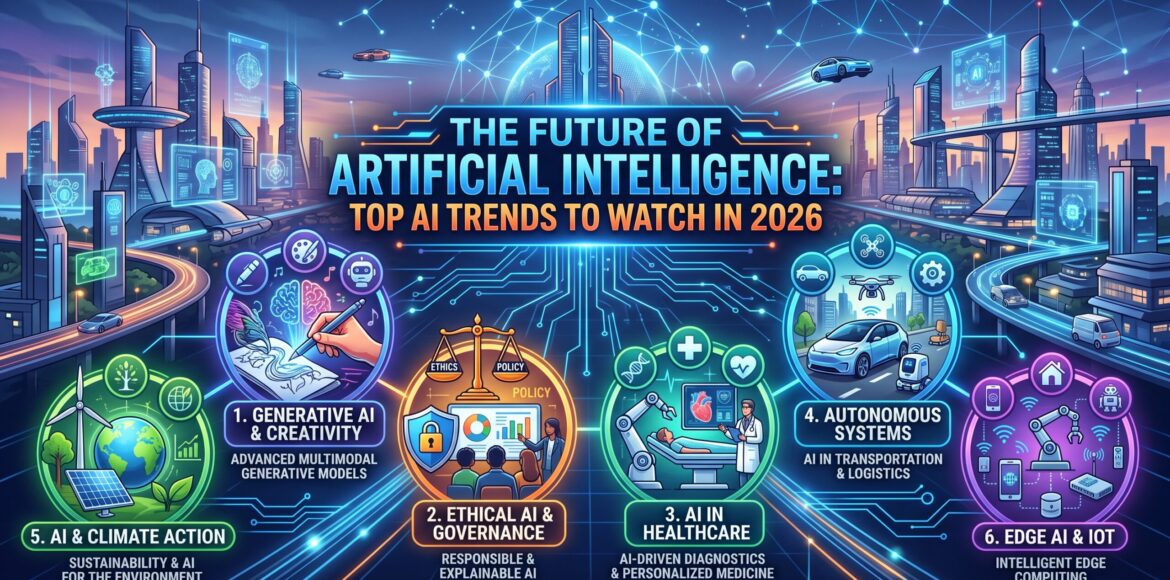
Table of Contents
Artificial intelligence has moved far beyond being a technology discussed mainly by researchers and technology companies. Today, AI is becoming part of how businesses work, how people search for information, how software is developed, how customer service is delivered, and how decisions are supported.
What makes 2026 particularly interesting is that AI is not simply becoming better at generating text or images. It is becoming more capable of reasoning, working with different types of information, using tools, completing tasks and operating inside real business processes.
The future of artificial intelligence will likely be shaped not by one single breakthrough, but by several technologies developing together. From AI agents and multimodal systems to edge computing and responsible AI, these trends are worth watching closely.
1. AI Agents Will Move From Chat to Action
One of the most important developments in the future of artificial intelligence is the growth of AI agents.
Traditional AI assistants mainly respond to questions. An AI agent can go a step further by using tools, accessing information, following instructions and completing a series of tasks.
For example, instead of asking an AI system to write a customer email, a business could use an AI agent to:
- Read a customer request
- Check relevant information
- Prepare a response
- Update a CRM
- Create a follow-up task
- Notify a sales representative
2. Generative AI Will Become More Practical
Generative AI became widely known through tools that create text, images, audio and video. The next stage is less about novelty and more about usefulness.
Businesses are increasingly looking at how generative AI can solve specific problems rather than simply experimenting with chatbots.
For example, companies can use generative AI for:
- Content creation
- Software development
- Customer support
- Document analysis
- Marketing
- Data summarization
- Internal knowledge systems
- Product research
- Training materials
3. Multimodal AI Will Become the Norm
AI systems are becoming better at understanding multiple forms of information at the same time.
This is known as multimodal AI.
Instead of working only with text, a multimodal system can potentially process combinations of:
Text
Images
Audio
Video
Documents
Charts
Other structured information
Imagine a customer uploading a product image and asking an AI assistant to identify an issue. The system could analyze the image, understand the written question and provide a response based on both.
For businesses, multimodal AI could improve customer service, education, healthcare applications, product support, marketing and many other workflows.
The future of artificial intelligence is therefore likely to be less text-only and much more interactive.
4. AI-Powered Automation Will Transform Business
Automation has existed for years, but AI is making automation more flexible.
Traditional automation generally follows predefined rules:
If X happens → perform Y.
AI-powered automation can handle more complicated situations by interpreting information and selecting an appropriate action.
For example, an AI-powered customer service workflow could identify the subject of a customer’s message, determine its urgency, search a knowledge base and either provide an answer or route the case to the appropriate employee.
5. Smaller and More Efficient AI Models
Large AI systems can require significant computing resources. Smaller models can be useful when organizations need lower costs, faster responses or greater control over where data is processed.
This could make AI more practical for:
- Small businesses
- Mobile applications
- IoT devices
- Private enterprise systems
- Specialized business applications
- Edge computing environments
6. Edge AI and On-Device Intelligence
Another major trend is Edge AI, where AI processing takes place closer to the device collecting or using the information.
Instead of sending every piece of data to a remote cloud server, some AI tasks can be performed directly on devices such as smartphones, cameras, sensors and industrial equipment.
This can offer several advantages, including:
- Faster responses
- Reduced network dependency
- Better privacy in certain applications
- Lower data-transfer requirements
- Real-time processing
For example, smart cameras could analyze activity locally rather than continuously sending video to a central server.
As hardware becomes more capable, edge AI could become an important part of connected products and IoT systems.
7. AI and Robotics Will Work More Closely Together
Robots have traditionally been designed to perform specific programmed movements. AI can help robots understand more complex environments and respond to changing situations.
This could influence industries such as:
- Manufacturing
- Warehousing
- Logistics
- Agriculture
- Healthcare
- Construction
- Home assistance
The combination of advanced AI models, computer vision, sensors and robotics could make machines more adaptable.
8. AI-Powered Cybersecurity
As organizations use more AI, cybersecurity will become even more important.
AI can help security teams identify unusual behavior, analyze large volumes of security information and detect potential threats more quickly.
For companies developing AI applications, security should be considered during design and development rather than added only after a system is launched.
9. Responsible AI and AI Governance
The future of artificial intelligence is not only about capability. It is also about trust.
Organizations need to consider questions such as:
- s the AI system producing reliable information?
- How is sensitive data handled?
- Can users understand important decisions?
- How are errors detected?
- Who is responsible when something goes wrong?
- How is AI monitored after deployment?
10. AI in Software Development
AI is also changing how software is created.
Developers can already use AI tools to help with:
- Code generation
- Debugging
- Documentation
- Testing
- Code explanation
- Refactoring
- Prototyping
The Future of Artificial Intelligence
The future of artificial intelligence will not be defined by one technology.
Instead, several developments are coming together: generative AI, AI agents, multimodal systems, automation, edge computing, robotics, cybersecurity and responsible AI.
The most important change may be the movement from AI as a standalone tool toward AI as part of everyday digital systems.
AI assistants will become more capable. Business workflows will become more automated. Software development will continue to change. Devices will become smarter. At the same time, businesses will need stronger approaches to security, privacy, governance and human oversight.
For organizations, the opportunity is significant—but so is the need to adopt AI thoughtfully.
The companies that benefit from AI will not necessarily be those that use the most AI. They will be the ones that understand where it can create genuine value and implement it responsibly.