
Agentic AI vs Generative AI: What Is the Difference?
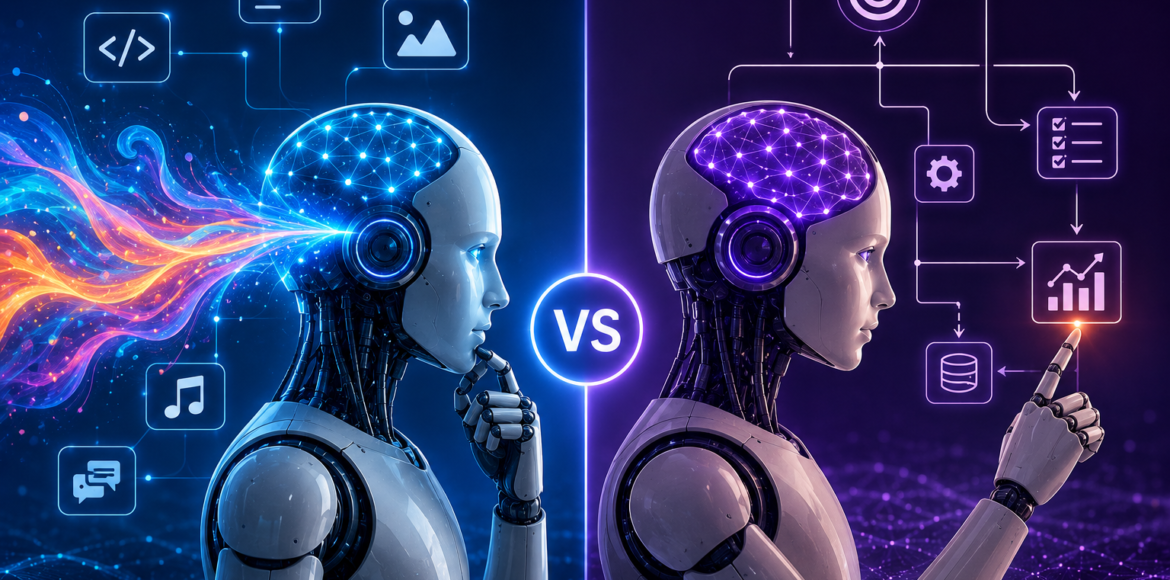
Table of Contents
Artificial intelligence is changing quickly. Just a few years ago, most people knew AI as something that could answer questions, recommend products, or help with simple tasks. Today, AI can write articles, create images, analyze information, generate code, and even perform tasks across different business systems.
Two terms you will hear frequently in 2026 are Generative AI and Agentic AI.
Although they are closely related, they are not the same thing.
Generative AI is mainly designed to create content and provide responses. Agentic AI goes a step further by helping plan and complete tasks toward a specific goal.
Understanding the difference is becoming increasingly important for businesses, developers, marketers, and everyday users because both technologies can solve different problems.
So, what exactly separates Agentic AI from Generative AI? And which one is more useful for your business?
Let’s break it down in simple terms.
What Is Generative AI?
Generative AI is artificial intelligence that can create new content based on instructions or prompts.
Instead of simply finding information that already exists, generative AI can produce something new.
For example, you can ask a generative AI tool to:
- Write a blog post
- Create a product description
- Generate an image
- Write computer code
- Summarize a document
- Create an email
- Generate ideas
- Translate content
- Create a presentation
- Analyze and explain information
The user provides an instruction, and the AI generates an output.
A simple example would be:
User: “Write a 500-word article about digital marketing.”
Generative AI: Creates the article.
The AI has completed the request by generating content.
This is why generative AI has become so popular among content creators, marketers, designers, developers, students, and businesses.
What Is Agentic AI?
Agentic AI refers to AI systems that can work toward a goal by planning tasks, making decisions, using available tools, taking actions, and evaluating results. If you want to explore the concept in more detail, read our guide on What Is Agentic AI? How Autonomous AI Agents Will Transform Business in 2026 to learn how autonomous AI agents are changing modern business workflows.
Instead of simply answering a prompt, an AI agent can potentially manage multiple steps required to complete a larger task.
For example, imagine you tell an AI agent:
“Help increase sales for our online store.”
A generative AI system might give you a list of marketing strategies.
An agentic AI system could potentially analyze approved sales data, identify underperforming products, research opportunities, prepare marketing recommendations, create campaign materials, monitor results, and suggest the next steps.
The important difference is action and autonomy.
Generative AI primarily creates.
Agentic AI can potentially plan, act, and adapt.
Agentic AI vs Generative AI at a Glance
The easiest way to understand the difference is to compare how they approach a task.
| Feature | Generative AI | Agentic AI |
| Main purpose | Creates content and responses | Completes goals and tasks |
| Typical interaction | Prompt → Response | Goal → Plan → Action → Result |
| Content generation | Yes | Yes, when needed |
| Planning | Limited or prompt-dependent | Core capability |
| Tool usage | May use tools | Often designed to use multiple tools |
| Decision-making | Usually within a single response | Can make decisions across a workflow |
| Multi-step tasks | Limited | Strong focus |
| Adaptation | Can revise output | Can evaluate results and adjust actions |
| Autonomy | Generally lower | Generally higher |
| Human involvement | Usually provides prompts and reviews output | Sets goals, permissions, and oversight |
This table does not mean every generative AI system works exactly the same way or that every AI agent is fully autonomous. The capabilities depend on how the system is designed.
The Biggest Difference: Creating vs Doing
The simplest way to explain the difference is this:
Generative AI creates.
Agentic AI works toward completing.
Suppose you run an online store and want to promote a new product.
You could ask generative AI:
“Write a Facebook post promoting this product.”
The AI generates the post.
Now imagine giving an AI agent a broader objective:
“Create and manage a promotional campaign for this product.”
The agent could potentially break the objective into smaller tasks, such as researching the target audience, creating campaign ideas, preparing content, checking performance data, and recommending changes.
The agent is not necessarily replacing the marketing team. Instead, it can help coordinate and automate parts of the workflow.
That distinction becomes especially important when businesses start connecting AI to real tools and systems.
How Generative AI Works
Generative AI typically begins with a prompt.
You provide an instruction, question, image, document, or other input. The AI processes that information and generates an output.
For example:
Input:
“Create five headlines for a cybersecurity blog.”
Output:
The AI provides five headline ideas.
You can then ask it to change the tone, shorten the headlines, make them more professional, or create additional options.
This interaction is extremely useful because the human remains actively involved in guiding the process.
Generative AI is therefore particularly valuable for tasks where the main requirement is producing or transforming information.
How Agentic AI Works
Agentic AI usually involves a more complex process.
Instead of simply generating an answer, an AI agent may follow a workflow such as:
Understand → Plan → Act → Observe → Evaluate → Adjust
For example, a company could ask an AI agent to monitor customer support requests.
The agent could:
- Receive a support request.
- Understand the customer’s problem.
- Search an approved knowledge base.
- Determine whether the issue is simple or complex.
- Prepare an appropriate response.
- Send the response if permitted.
- Escalate unusual cases to a human.
- Monitor the outcome.
The exact capabilities depend on the system, its tools, and the permissions given to it.
This is what makes agentic AI particularly interesting for business automation.
A Simple Real-World Example
Let’s say you own a marketing agency.
Your team receives dozens of customer inquiries every day.
Using Generative AI
You could ask AI:
“Write a professional response to this customer asking about our SEO services.”
The AI writes the response.
A team member reviews it and sends it.
Using Agentic AI
You could potentially configure an AI agent to handle the broader workflow.
It might:
- Read the incoming inquiry
- Identify the customer’s needs
- Check approved customer information
- Determine which service is relevant
- Find suitable information from your knowledge base
- Prepare a personalized response
- Create a CRM record
- Assign the lead to a salesperson
- Schedule a follow-up task
The important point is that the agent is working through a process, not simply generating one piece of text.
Where Generative AI Is Most Useful
Generative AI is already useful across many industries.
Content Marketing
Businesses can use it to brainstorm topics, create outlines, draft articles, write social media posts, and develop email ideas.
Human review remains important because businesses need accurate, original, brand-appropriate content.
Design and Creative Work
Generative AI can help create images, concepts, illustrations, presentations, and other creative materials.
Designers can use these outputs as starting points rather than treating AI as a complete replacement for creative direction.
Software Development
Developers can use generative AI to explain code, generate code snippets, create documentation, identify potential bugs, and explore different implementation approaches.
Customer Communication
AI can help draft emails, support responses, product descriptions, and other customer-facing content.
Research and Summarization
Generative AI can summarize large amounts of information and help users understand complicated material more quickly.
Where Agentic AI Is Most Useful
Agentic AI becomes particularly interesting when a business has repetitive, multi-step workflows.
Customer Service
An AI agent can potentially classify requests, find information, prepare responses, and route complicated cases to employees.
Sales
AI agents can help research leads, update CRM information, prepare follow-ups, and identify opportunities that need attention.
Marketing
An agent could potentially monitor campaign performance, analyze results, prepare content, and recommend adjustments.
Business Operations
AI agents can help monitor inventory, process documents, track workflows, and identify operational problems.
IT and Software Development
Agents can potentially investigate issues, run tests, monitor systems, and assist developers with multi-step technical tasks.
Data Analysis
Instead of simply answering a data question, an AI agent could potentially gather information from approved sources, analyze it, identify patterns, and prepare a report.
Can Agentic AI Use Generative AI?
Yes.
In fact, this is one of the most important things to understand.
Agentic AI and Generative AI are not competitors.
Agentic AI can use generative AI as one of its capabilities.
Think of it this way:
Generative AI can be the brainpower used to create content, reason about information, or generate possible actions.
An AI agent can use those capabilities as part of a larger workflow.
For example, an AI agent managing a marketing task could use generative AI to write an email while the agent itself handles the surrounding workflow.
It could decide what information is needed, gather approved data, ask the generative model to draft content, check the result, and then move to the next permitted step.
So, rather than thinking:
Agentic AI OR Generative AI
It is often more useful to think:
Agentic AI + Generative AI
Why Agentic AI Is Becoming Important in 2026
Businesses have already discovered the value of generative AI.
However, many companies now want more than content generation.
They want AI to help with actual workflows.
A company does not necessarily need another tool that simply writes an email. It may want technology that can identify which customers need an email, gather the relevant information, prepare the message, and create a follow-up task.
This is where agentic AI becomes attractive.
The focus is moving from:
“What can AI generate?”
toward:
“What can AI help us accomplish?”
That shift could have a major impact on business operations.
Benefits of Generative AI
Generative AI offers several advantages.
Faster Content Creation
AI can produce first drafts much faster than starting from a blank page.
More Ideas
It can generate multiple concepts, headlines, approaches, and variations quickly.
Increased Productivity
Employees can use AI to reduce time spent on repetitive writing, summarization, and research tasks.
Easier Access to Information
People can ask questions in natural language instead of learning complicated software interfaces.
Creative Assistance
AI can help professionals explore ideas that they may not have considered.
However, speed should not come at the expense of accuracy, originality, or human judgment.
Benefits of Agentic AI
Agentic AI offers a different set of advantages.
Workflow Automation
Agents can potentially manage several connected steps instead of handling only one task.
Continuous Monitoring
Some AI agents can monitor approved systems and identify issues that need attention.
What Are the Risks?
Both technologies have risks, but agentic AI introduces additional considerations because it can potentially take actions.
Generative AI Risks
Generative AI may:
- Produce inaccurate information
- Create misleading content
- Reflect biases
- Generate low-quality content
- Misunderstand user instructions
Human review remains important, especially for professional and high-impact content.
Will Agentic AI Replace Human Workers?
This is one of the biggest questions surrounding AI.
The answer is more complicated than a simple yes or no.
AI is likely to automate certain tasks. However, businesses still need people for leadership, creativity, relationship building, ethical decisions, strategy, communication, and accountability.
For many organizations, the more realistic future is human-AI collaboration.
An employee may give an AI agent a goal, monitor its progress, review important decisions, and step in when something unusual happens.
This could allow employees to spend less time on repetitive administrative work and more time on higher-value activities.
The Future: From AI Tools to AI Teammates
The evolution of AI is becoming easier to see.
First, AI helped people find information.
Then, generative AI helped people create information.
Now, agentic AI is pushing toward systems that can help people get work done.
That does not mean every AI system will become fully autonomous. In fact, many business environments will continue to require human approval for important actions.
Instead, the future may involve AI systems that work alongside employees as digital teammates.
A person might say:
“Analyze this week’s sales performance and identify what needs my attention.”
The AI could gather approved information, analyze it, highlight important changes, and present recommendations.
The employee then makes the final decision.
That model combines the speed of AI with the judgment of people.